
Competitive intelligence brief template your team will read
A copy-ready weekly brief in Markdown, the rules for filling each section, and the editing choices that keep it under one screen so decisions follow from it.

In this article
Open the last competitor update your team shared and count the items in it. Then count how many led to a decision.
For most teams the first number is around twenty and the second is zero. The update lists everything a competitor did and leaves the reader to work out what any of it means. People skim it twice, then stop opening it.
A brief that gets read is short, says what changed, and says what to do about it. The template below fits on one screen. Copy it, then use the rest of this article to fill it in well.
The template, ready to copy
# Competitive brief: week of [date]

Owner: [name]
Competitors covered: [three names at most]

## The one change that matters

[Competitor] [did what] on [date].

- Why it matters to us: [one sentence tied to a goal, a deal, or a roadmap item]
- Evidence: [link to the source]
- Confidence: [high / medium / low] because [reason]
- Recommended response: [log / inform / act]
- Owner and date: [name], [date]

## Other changes worth knowing

- [Competitor]: [what changed]. [Why it matters in one sentence]. [link]
- [Competitor]: [what changed]. [Why it matters in one sentence]. [link]
- [Competitor]: [what changed]. [Why it matters in one sentence]. [link]

## Decisions needed

- [Question that needs an answer], from [name], by [date]

## Still watching

- [Open question carried over from an earlier brief]

## Logged, no action

[Number] other changes recorded in [link to the full log].
Save the file where your product team already works. A brief in a tool nobody opens has the same effect as no brief.
How to fill each section
The one change that matters
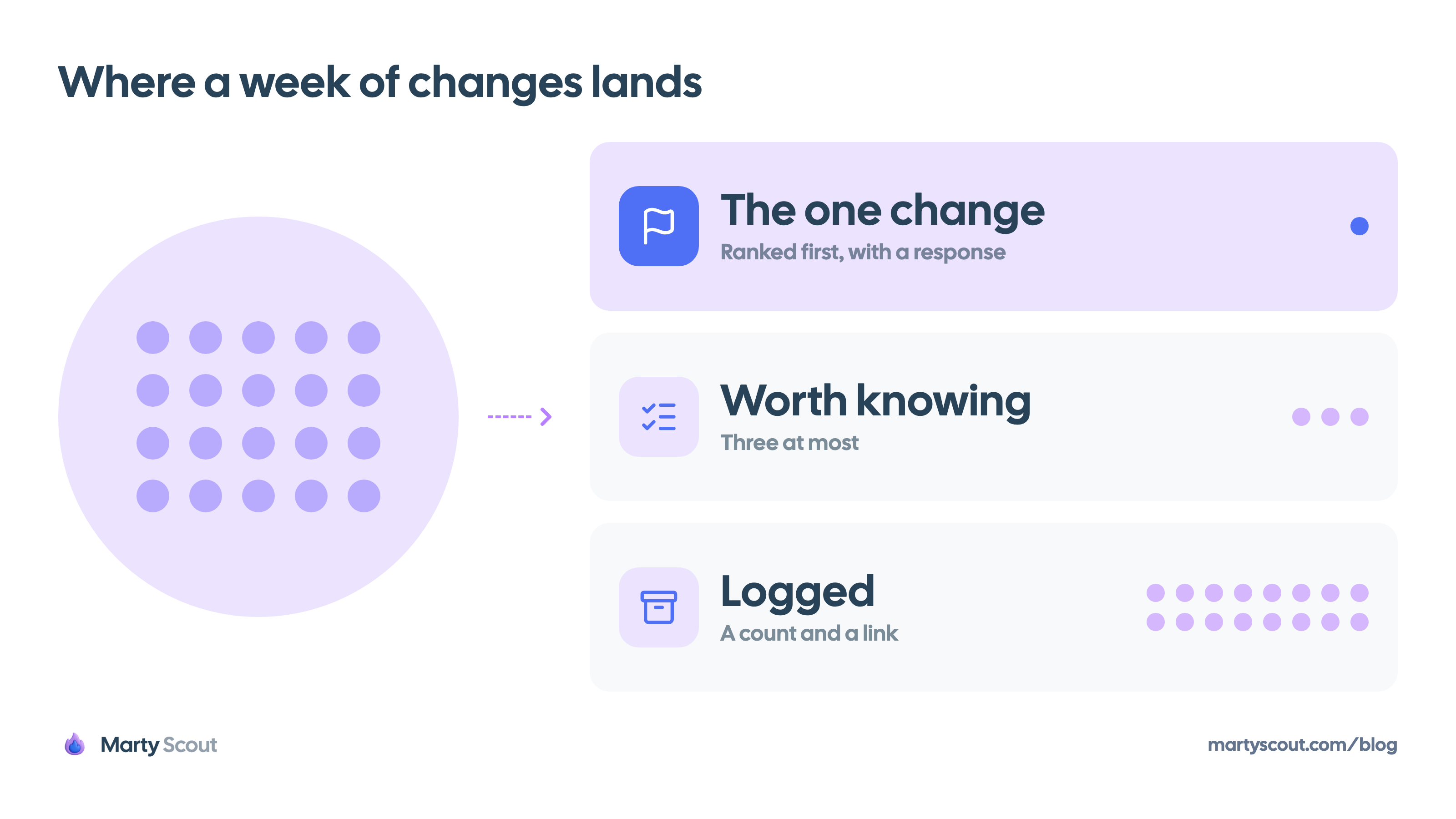
This section is the brief. Everything below it is supporting material.
Pick a single change. If two feel equally important, choose the one tied to a decision your team makes this month. Forcing a ranking is the point: the reader learns what you think matters most, and can disagree.
Write the change as a fact with a date. "Acme moved audit logs from Enterprise to Business on September 3" is a fact. "Acme is getting more aggressive on pricing" is an opinion, and nobody can check it.
Then tie it to something your team owns. A goal, a deal in progress, or an item on the roadmap. If you can't make that connection in one sentence, the change belongs in a lower section.
Other changes worth knowing
Three items at most. Each one gets the same three parts: what changed, why it matters, and a link.
An item with no "why it matters" sentence is a news headline. Cut it or move it to the log.
Decisions needed
List questions, not topics. "Should we move SSO to the Team plan?" can be answered. "SSO packaging" can't.
Name who needs to answer and by when. Leave the section empty when there's nothing to decide. An empty section is honest, and it keeps the section meaningful on the weeks when it has an entry.
Still watching
Some signals need more time. A job posting hints at a new product line. A beta appears in a changelog. Carry these from brief to brief until they resolve, then remove them.
This section is your memory. Without it, every brief starts from zero and slow-moving stories are missed.
Logged, no action
One line with a count and a link. It shows the reader you saw the other changes and chose to leave them out.
A filled-in example
Here's the top of a brief for a fictional scheduling product. The company names are invented.
# Competitive brief: week of September 21

Owner: Dana
Competitors covered: Calendra, Meetwise, Slotly

## The one change that matters

Calendra moved round-robin routing from Enterprise to Team on September 17.

- Why it matters to us: routing is the main reason mid-size sales teams
  pick our Business plan, and it came up in two open deals.
- Evidence: pricing page diff, September 16 and September 17
- Confidence: high, because the change is live on the public pricing page
- Recommended response: inform
- Owner and date: Dana briefs sales by September 24

## Decisions needed

- Do we review Business plan packaging this quarter? From Priya, by October 2
Notice what's absent. There's no summary of Calendra's blog posts, no list of new hires, and no screenshot gallery. Those are in the log for anyone who wants them.
The brief gives a salesperson what to expect in the next call, and gives the head of product one question with a deadline.
Match the cadence to the decision
A weekly brief is the default, not the only option. The right cadence depends on how fast the decisions it feeds are made.
| Cadence | Best for | Length | Risk |
|---|---|---|---|
| Daily | Sales teams in active deals, launch weeks | Three lines | Turns into noise within a month |
| Weekly | Product and product marketing teams | One screen | Skipped when the owner is busy |
| Monthly | Leadership and roadmap planning | One page with trends | Too slow for pricing and launch moves |
Many teams end up with two: a short daily or weekly signal for the people close to the market, and a monthly summary for leadership. The monthly one is written from the weekly ones, so it costs little extra.
Four editing choices that keep it readable
The template is deliberately small. These choices are what keep it small once real information arrives.
Rank, don't list
A list treats twenty changes as equal. A ranking tells the reader where to spend two minutes. The top section holds one change for this reason.
Separate the fact from the reading
"They raised the Pro plan from $49 to $59" is a fact. "They're confident in demand" is your reading of it. Keep them in separate sentences, so a reader who disagrees with the reading still trusts the fact.
State your confidence
A pricing change you saw on the public pricing page is high confidence. A product direction inferred from two job postings is low. Say which one the reader is looking at. It costs three words and prevents a low-confidence guess from becoming a roadmap item.
Recommend a response
Each top item ends with one of three words.
- Log: no effect on customers or plans. Record it.
- Inform: affects live deals or messaging. Tell the people who need it.
- Act: changes what customers expect from you. Open a decision with an owner and a date.
Most items are "log." A brief where everything is "act" will be ignored as fast as one with no recommendations. For launches, the launch response framework gives a way to score the choice.
What the brief costs to produce
The template takes ten minutes to fill in. Collecting what goes into it takes far longer, and this is where most competitive intelligence efforts stop.
To fill one weekly brief for three competitors, someone has to check each competitor's changelog, pricing page, blog, job board, and social accounts, plus the news and review sites. Then they read all of it and discard most of it.
Done by hand, the collecting crowds out the thinking. The owner spends the available time gathering links and has none left to decide what matters. The brief arrives late, or it arrives as a list.
Split the work along this line:
- Collection is repetitive and rule-based. Automate it. Page monitors, feed readers, and AI agents all handle it, and the routine for tracking competitor pricing changes shows the setup for one source.
- Filtering depends on context: your goals, your roadmap, your deals. An agent can do a first pass if it knows this context. A person should still review it.
- Recommending a response is judgment. Keep it with the owner.
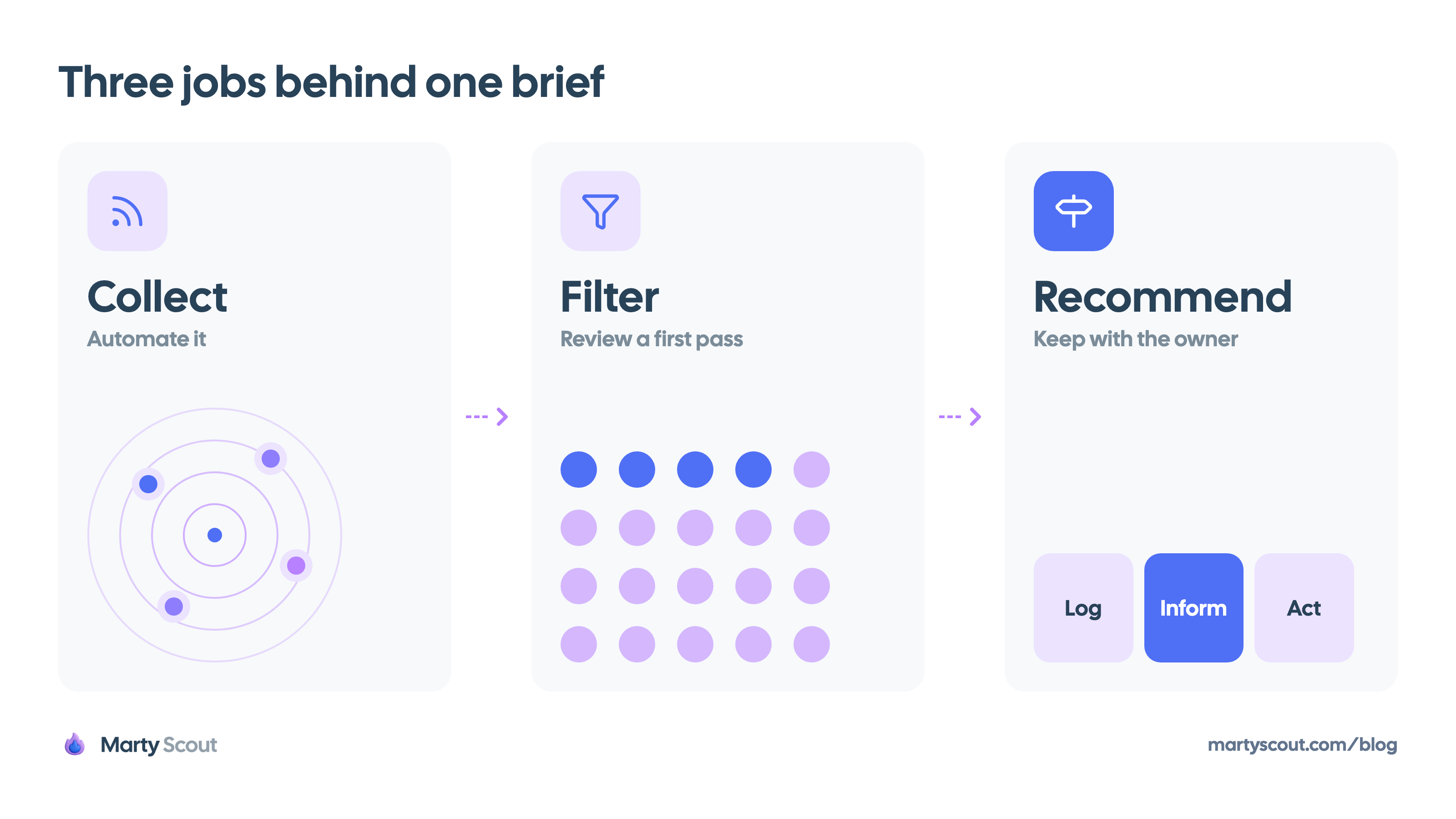
The brief improves when the owner's time moves from the first job to the third.
Write the first one with what you have
Your first brief doesn't need a monitoring setup. Spend thirty minutes on three competitors, pick the one change that matters, and send it.
Then watch what happens. If someone replies with a question or a decision, the format works. If nobody does, shorten it and send the next one.
FAQ
What is a competitive intelligence brief?
A short, recurring document that tells a team what changed among its competitors, why it matters, and what to do about it. It differs from a competitor analysis, which is a one-time deep study of a competitor's product, pricing, and positioning.
How long should a competitive brief be?
One screen. A reader should reach the recommended response in under two minutes. Anything longer belongs in a linked log.
Who should write the brief?
One named owner, usually a product marketing manager or a product manager. Input can come from sales, support, and engineering, but one person ranks the changes and signs the recommendation.
How many competitors should a brief cover?
Three at most. Choose the ones you meet most often in deals. Covering more spreads attention thin and pushes the brief past one screen.
What sources should feed the brief?
Public sources the competitor controls, such as its changelog, pricing page, blog, documentation, and job board. Add third-party sources like news, review sites, and social posts, and first-party ones like notes from your own sales calls and lost deals.
Related articles
Competitor analysis and benchmark templates that decide
Two copy-ready worksheets: one competitor and one question, or one metric across several. Every cell carries a source, a date, or an honest blank.
Compare competitor prices when every plan meters differently
Seats, credit pools, and per-outcome fees can't share one price column. Price three buyer profiles on every competitor instead, with a worked example.
Match market research tools to the decision in front of you
Three jobs hide inside every top market research tools list: paid respondents, public landscape sources, and competitor monitoring. Pick one per decision.